
A simple kitchen design doesn’t mean boring, it means purposeful. It’s about cutting the visual clutter, choosing materials that work hard without shouting for attention, and creating a space where you can actually cook without hunting for a measuring cup buried behind three unused gadgets. Whether you’re planning a full remodel or just tired of countertops that look like a yard sale, these strategies will help you create a kitchen that’s clean, functional, and surprisingly easy to maintain. No Pinterest fantasies required, just practical improvements you can start this weekend.
Table of Contents
ToggleKey Takeaways
- Simple kitchen design reduces visual clutter and decision fatigue, making meal prep faster and small kitchens feel larger while maintaining timeless appeal for future resale.
- Streamlined cabinetry with flat-panel slab-front doors, integrated pulls, and smart internal organizers creates a clean exterior while maximizing functional storage.
- A neutral color palette of white, light gray, or greige combined with large-format subway tiles and minimal grout lines maintains visual calm and requires less maintenance.
- Budget-friendly improvements like painting existing cabinets, replacing hardware, installing peel-and-stick backsplashes, and decluttering countertops can transform your kitchen without a full remodel.
- Smart kitchen layout positioning the sink, stove, and refrigerator within a 12–26 foot work triangle with proper landing space ensures efficiency and prevents functional obstacles.
- Declutter by editing possessions to daily-use items, eliminating duplicates, and using drawer dividers and vertical storage systems to keep your simple kitchen design functional long-term.
Why Simple Kitchen Design Works for Modern Homes
Simple kitchen design has gained traction because it solves real problems: too much stuff, too little counter space, and too many finishes fighting for attention. Modern homes, especially those under 2,000 square feet, can’t afford wasted space on decorative corbels or open shelving that collects grease.
A streamlined kitchen reduces decision fatigue. When everything has a designated spot and surfaces stay clear, meal prep becomes faster. You’re not moving appliances around or digging through drawer clutter to find the can opener. The visual calm also makes small kitchens feel larger, critical in homes where the kitchen opens directly into the living area.
From a resale perspective, simple designs age better. Trendy tile patterns and ornate cabinet hardware date a kitchen quickly, while flat-panel cabinets, neutral countertops, and integrated appliances stay relevant for decades. Buyers can envision their own style without needing to rip out your statement backsplash first.
Maintenance is another win. Fewer seams, less ornamentation, and smooth surfaces mean less time scrubbing. Slab backsplashes (a single sheet of quartz or porcelain) eliminate grout lines entirely. Handleless cabinets with push-to-open mechanisms remove another dust-collecting surface. If you’ve got better things to do than detail twenty drawer pulls every week, simple design pays off daily.
Essential Elements of a Simple Kitchen Design
Streamlined Cabinetry and Storage Solutions
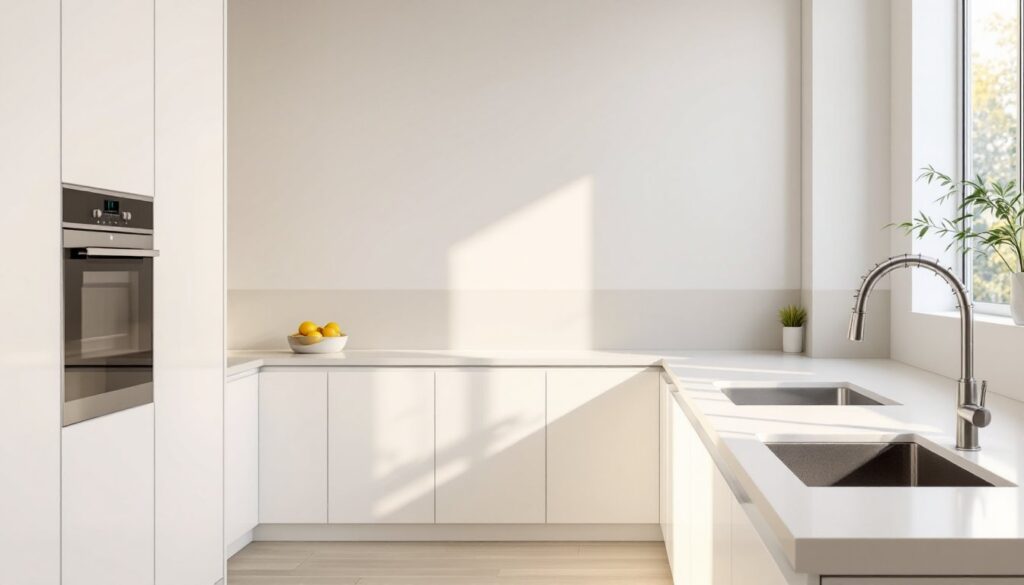
Cabinetry sets the tone. For a simple look, go with full-overlay, slab-front doors, no raised panels, no beading, no glass inserts. These flat faces reflect light evenly and don’t create shadows that chop up wall space. Material choices include MDF with a painted finish, thermofoil (a budget-friendly option with a smooth, sealed surface), or veneer-core plywood if you want stained wood without visible grain patterns going wild.
Skip ornate hardware or eliminate it entirely. Integrated pulls (where the door edge has a routed grip) or touch-latch mechanisms keep the face completely clean. If you prefer handles, choose simple bar pulls in brushed nickel or matte black, both finishes hide fingerprints better than polished chrome.
Inside the cabinets, invest in organizers that actually work: pull-out trash bins, deep drawer dividers for pots, and lazy Susans in corner cabinets. These aren’t trendy, they’re standard in functional kitchens. A simple exterior means nothing if you’re still shoving sheet pans in sideways and hoping the door closes.
Tall pantry cabinets (often 84 inches or 96 inches to the ceiling) offer massive storage without upper cabinets crowding the walls. Pair them with open counters or a single row of uppers, and the room breathes. If codes or layout allow, consider a floor-to-ceiling cabinet wall on one side of the kitchen, it centralizes storage and leaves other walls uncluttered.
Neutral Color Palettes That Create Calm
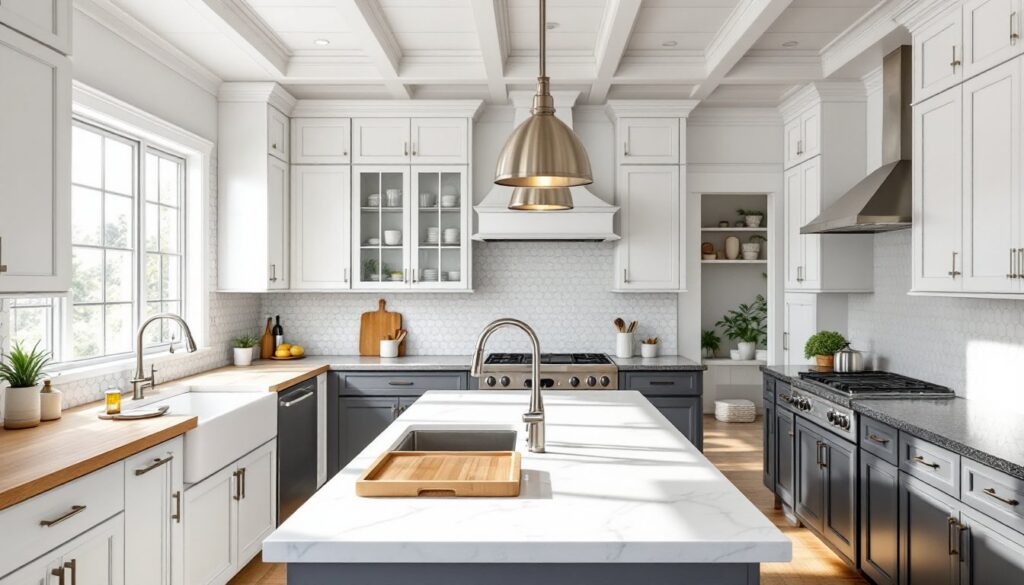
Neutral doesn’t mean beige overload. It means a limited, cohesive palette that doesn’t compete with itself. Start with cabinets in white, off-white (like Benjamin Moore’s White Dove or Sherwin-Williams’ Alabaster), light gray, or greige (a gray-beige hybrid). These bases pair with almost any countertop and flooring without requiring a design degree.
For countertops, quartz in solid white or soft gray is low-maintenance and visually quiet. Butcher block works if you want warmth, just know it requires periodic oiling and isn’t as stain-resistant. Concrete-look porcelain slabs give an industrial edge without the sealing headaches of actual concrete.
Backsplashes should recede, not announce themselves. A simple slab backsplash in the same material as your counters creates a seamless look and eliminates grout maintenance. If you want tile, go with large-format subway tiles (4×12 inches or 3×12 inches) in white or light gray, laid in a straight stack bond (no offset) for a modern grid. Use light gray grout, white stains, dark grout creates a busy grid effect.
Flooring can introduce subtle texture: wide-plank luxury vinyl in a muted oak tone, large-format porcelain tile (12×24 inches minimum) in gray or taupe, or polished concrete if your slab is in good shape and you’re comfortable with the industrial look. Whatever you choose, keep it uniform with adjacent spaces. Abrupt floor transitions chop up sightlines.
Budget-Friendly Ways to Achieve a Simple Kitchen Look
You don’t need a gut renovation to simplify. Start with what’s visible.
Paint existing cabinets instead of replacing them. Remove doors, clean thoroughly with a degreaser like TSP, sand lightly with 120-grit then 220-grit sandpaper, prime with a bonding primer (Benjamin Moore’s Advance or Zinsser B-I-N), and finish with a semi-gloss or satin cabinet paint. Use a foam roller for doors and a small brush for edges, two coats minimum. If your cabinets have dated raised panels, you can’t make them flat, but a monochrome paint job reduces their visual weight.
Replace hardware with simple pulls or remove it altogether if your doors can handle touch latches (test before drilling new holes). Bar pulls cost $2–$10 each, budget $100–$200 for a full kitchen.
Swap out the backsplash. Remove old tile (wear safety goggles and a dust mask, and expect mess), patch and smooth the drywall, then install a peel-and-stick backsplash in large-format subway or solid color for $1.50–$4 per square foot. Or go bold and install a single quartz slab backsplash between counter and uppers for $200–$600 depending on size. It’s one seam, no grout, and looks high-end.
Declutter countertops. Store appliances you don’t use daily. A toaster, coffee maker, and knife block crowding the counter creates visual noise. Move them into a cabinet or a roll-out appliance garage if you have the space. Kitchens featured on design-focused sites often show completely clear counters because it photographs well, and because it actually works in real life.
Update lighting. Replace a dated fixture with a simple pendant or flush-mount LED in black, white, or brushed metal. Under-cabinet LED strips ($20–$60 for plug-in kits, $100+ for hardwired) add task lighting and make counters feel larger. Avoid color-changing RGB strips unless you want your kitchen to look like a gaming rig.
Refinish or paint your floor if it’s solid hardwood. A light stain or a coat of porch paint in gray or white freshens the space for under $100 in materials. If it’s worn vinyl or linoleum, install peel-and-stick luxury vinyl planks yourself for $1.50–$3 per square foot. Just make sure the subfloor is smooth, every bump telegraphs through.
Simple Kitchen Layouts That Maximize Function
Layout trumps finishes. A beautiful backsplash won’t fix a kitchen where the sink, stove, and fridge form an obstacle course.
The work triangle, the path between sink, range, and refrigerator, should total 12 to 26 feet with no side longer than 9 feet. If your layout allows, position these three points to form a rough triangle, minimizing steps during meal prep. In tight spaces, a galley layout (two parallel runs of counters) keeps everything within arm’s reach, though it can feel cramped with multiple cooks.
For open-plan homes, an L-shaped layout with a small peninsula or island defines the kitchen without walls. Keep the island simple: a countertop overhang of 12 to 15 inches allows for 24-inch-deep bar stools underneath. If you’re adding electrical for outlets (required by NEC code every 4 feet along countertops), hire a licensed electrician or pull a permit if you’re comfortable with basic wiring, it’s not a cosmetic task.
Avoid placing the sink or cooktop in an island unless you’ve planned for proper venting. A downdraft vent works for low-heat cooking but struggles with high-BTU gas ranges. An overhead vent requires ductwork running under the floor or overhead, which often means a structural change.
Landing space matters: leave at least 15 inches of counter on the latch side of the fridge, 15 inches beside the cooktop, and 24 inches on one side of the sink. This isn’t decorative, it’s where you set down hot pots and grocery bags without juggling.
Keep walkways 36 to 42 inches wide for a single cook, 48 inches if two people regularly work together. Measure before you commit to an island. A 10×10 kitchen can’t handle a 4×8 island without turning the aisles into a sideways shuffle.
Decluttering Tips for a Minimalist Kitchen
Minimalism isn’t about owning three forks. It’s about editing down to what you actually use and storing it logically.
Start with a full inventory. Pull everything out of cabinets and drawers. Sort into three piles: use daily, use occasionally, and never use. The third pile goes, donate, sell, or trash. The second pile (holiday platters, the waffle iron you fire up twice a year) gets stored in upper cabinets, the pantry, or even the basement if you have one. Daily items stay in the prime real estate: drawers and lower cabinets within arm’s reach of your main work zones.
Duplicate tools are a big offender. You don’t need four spatulas, three can openers, or two sets of measuring cups unless you’re running a catering business. Keep the best one, ditch the rest.
For small appliances, apply the “last 30 days” rule. If you haven’t used it in a month, it doesn’t live on the counter. A well-organized kitchen keeps appliances in cabinets with easy access, not crowding every square inch of workspace.
Drawer dividers and cabinet organizers aren’t optional. Without them, utensils migrate, lids go missing, and you end up buying a fourth peeler because you can’t find the other three. Bamboo or plastic dividers cost $10–$30 per drawer and take five minutes to install. For pot lids, try a vertical file organizer mounted inside a cabinet door or a pull-out rack in a base cabinet.
Pantry items should be decanted into clear, airtight containers if you have the space and patience. It looks clean, keeps food fresh, and makes it obvious when you’re low on flour. Label everything, masking tape and a Sharpie work fine.
Vertical storage recovers wasted space. Hang a magnetic knife strip instead of using a countertop block. Mount a rail system with S-hooks for utensils. Install a pull-out spice rack in a narrow cabinet (some are only 3 inches wide). Use stackable shelf risers inside cabinets to double your usable height.
Finally, enforce a one-in, one-out rule. New colander? Old one leaves. This prevents the slow creep back to clutter and keeps your kitchen functioning instead of just looking good for a week.