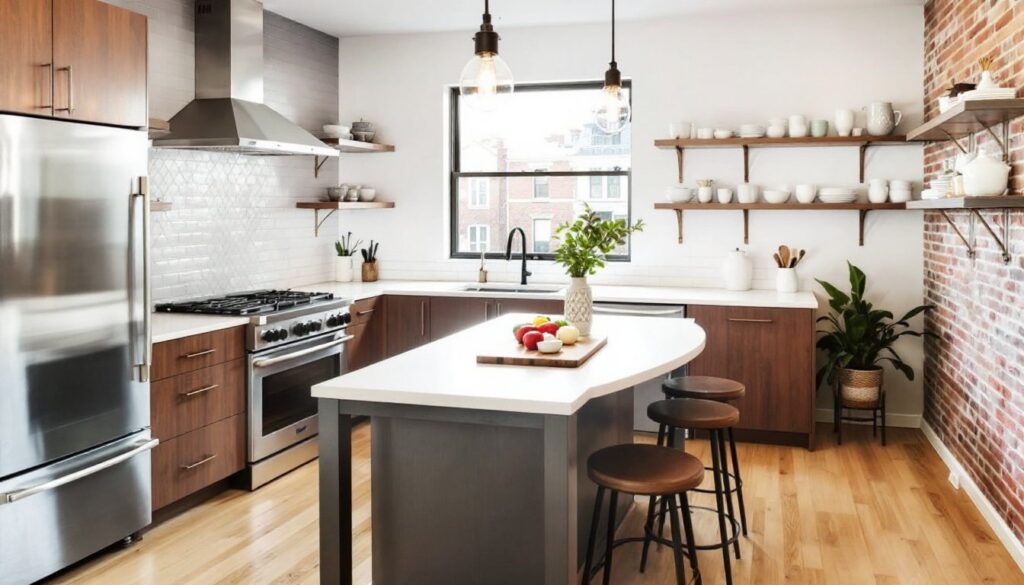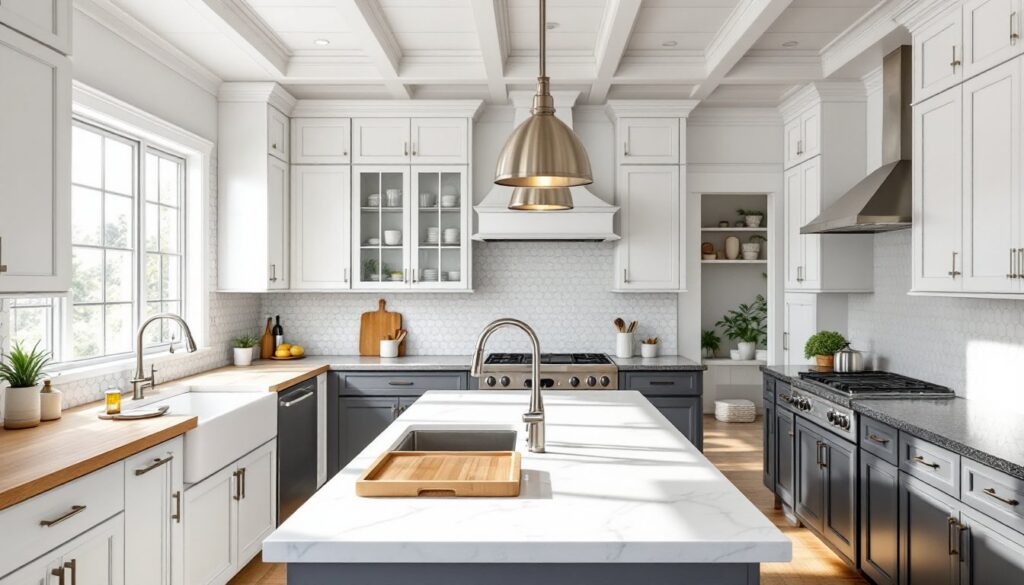

Choosing a kitchen countertop isn’t just about picking a color, it’s a structural, functional, and aesthetic decision that affects how the space performs for years. The right surface needs to handle knife work, hot pans, spills, and daily wear while tying together cabinetry, backsplash, and flooring. With material options spanning granite, quartz, butcher block, and emerging recycled composites, homeowners face more choices than ever. This guide breaks down the major countertop categories, design considerations, and trade-offs so anyone planning a kitchen remodel or new build can make an well-informed choice.
Table of Contents
ToggleKey Takeaways
- Selecting the right kitchen countertop design requires balancing material performance, aesthetics, and lifestyle needs—granite, quartz, and butcher block each serve different cooking habits and design styles.
- Quartz and sealed granite are ideal for kitchens with frequent cooking, acidic foods, and spills, while marble demands careful use and suits lower-traffic zones like islands or baking areas.
- Countertop color and veining affect both functionality and space perception: light surfaces brighten kitchens and show messes easily, while dark options add drama but require more frequent cleaning.
- Edge profiles ranging from simple eased edges to decorative ogee curves influence the final aesthetic—rounded edges prioritize safety in homes with children, while mitered waterfall edges define modern kitchen countertop design.
- Budget ranges from $20–50 per square foot for laminate to $150+ for rare marble and ultra-compact surfaces, but durability, regional pricing, and fabrication complexity all impact the true installed cost.
- Visit stone yards with cabinet and backsplash samples in natural light, and hire professional installers to ensure proper substrate support and warranty coverage—DIY installation risks damage to expensive slabs.
Understanding Your Kitchen Countertop Options
Material selection drives everything else, cost, durability, maintenance, and visual impact. Breaking down options into natural stone versus engineered or eco-friendly materials helps narrow the field.
Natural Stone Countertops
Granite remains a workhorse in kitchen design. It’s heat-resistant, scratch-resistant, and available in hundreds of color variations from quarries worldwide. Slabs typically measure 9–10 feet long and come in 2 cm (~3/4″) or 3 cm (~1-1/4″) thickness. Thicker slabs don’t require plywood backing and give a more substantial edge profile. Granite does require periodic sealing, usually once a year, to prevent staining, especially on lighter colors. Expect to pay $40–$100 per square foot installed, depending on rarity and origin.
Marble offers unmatched elegance but demands more care. Carrara, Calacatta, and Statuario are popular varieties, each with distinct veining. Marble is softer than granite (3–5 on the Mohs scale vs. granite’s 6–7), so it etches from acidic foods like lemon juice or vinegar and scratches more easily. Many designers recommend marble only for baking zones or island tops in low-traffic kitchens. Honed finishes hide etching better than polished. Pricing starts around $50 per square foot and climbs quickly for premium veining.
Soapstone is non-porous and doesn’t require sealing, making it low-maintenance. It darkens naturally over time and can be treated with mineral oil to speed the patina. Soapstone is softer (1–5 Mohs), so it will scratch, but scratches can be sanded out. It’s a favorite in historic and farmhouse kitchens. Expect $70–$120 per square foot installed.
Quartzite (not to be confused with quartz) is a natural metamorphic stone harder than granite. It offers marble-like looks with better durability but still requires sealing. Pricing overlaps with high-end granite.
Engineered and Eco-Friendly Materials
Quartz (engineered stone) dominates the mid-to-high-end market. It’s 90–94% ground natural quartz bound with polymer resins and pigments. The result is a non-porous, zero-maintenance surface that resists stains and doesn’t need sealing. Unlike granite, quartz slabs are consistent in color and pattern, which can be an advantage or a drawback depending on the look someone wants. Quartz isn’t heat-proof, hot pans can scorch the resin, so trivets are a must. Popular brands include Caesarstone, Cambria, and Silestone, typically running $50–$150 per square foot installed.
Solid surface (like Corian) is a blend of acrylic polymer and minerals. It’s repairable, scratches and burns can be sanded out, and seams can be made nearly invisible. It’s less heat-resistant than stone and can scorch or melt. Pricing ranges from $35–$85 per square foot.
Butcher block brings warmth and a traditional work-surface feel. Edge-grain maple, walnut, or oak slabs (typically 1-1/2″ thick) are common. Wood requires regular oiling with food-safe mineral oil or a specialized wood conditioner to prevent drying and cracking. It will scratch and dent, but many consider that part of the character. For food-prep areas, keep the wood unfinished or use food-safe finishes. Cost runs $30–$80 per square foot installed.
Recycled materials like Paperstone (compressed paper and resin) or terrazzo-look composites made from recycled glass are gaining traction among eco-conscious remodelers. These surfaces often carry third-party environmental certifications and perform comparably to solid surface or quartz. Pricing is similar to mid-range quartz.
Laminate has come a long way. Modern high-pressure laminates mimic stone, wood, and concrete convincingly and cost $20–$50 per square foot installed. They’re not heat-resistant and edges can chip, but they’re a practical choice for budget remodels or rentals.
How to Match Countertops with Your Kitchen Style
Countertop choice should reinforce the overall design language, not fight it. Here’s how to pair materials with common kitchen styles.
Traditional or classic kitchens lean on natural materials with rich, warm tones. Granite in shades of brown, gold, or black pairs well with raised-panel cabinetry. Marble, especially honed Carrara, works in butler’s pantries or on islands. Ogee or dupont edge profiles add formality.
Modern or contemporary spaces favor clean lines and solid colors. White, gray, or black quartz with a simple eased or mitered edge keeps the look minimal. Waterfall edges (where the countertop material continues down the sides of an island) are a signature modern detail. Concrete and ultra-compact surfaces like Dekton also fit this aesthetic.
Farmhouse or cottage kitchens do well with butcher block, soapstone, or white marble. These materials age visibly and develop patina, which suits the lived-in farmhouse vibe. Pair with an undermount apron-front sink and simple edge profiles like half-bullnose.
Industrial or urban loft kitchens can handle raw materials, polished concrete, stainless steel, or even soapstone with its natural veining. These surfaces are durable and unpretentious.
Transitional kitchens (blending traditional and contemporary) benefit from versatile materials like quartz in neutral tones or granite with subtle movement. A simple edge profile like eased or half-bullnose works in nearly any transitional space.
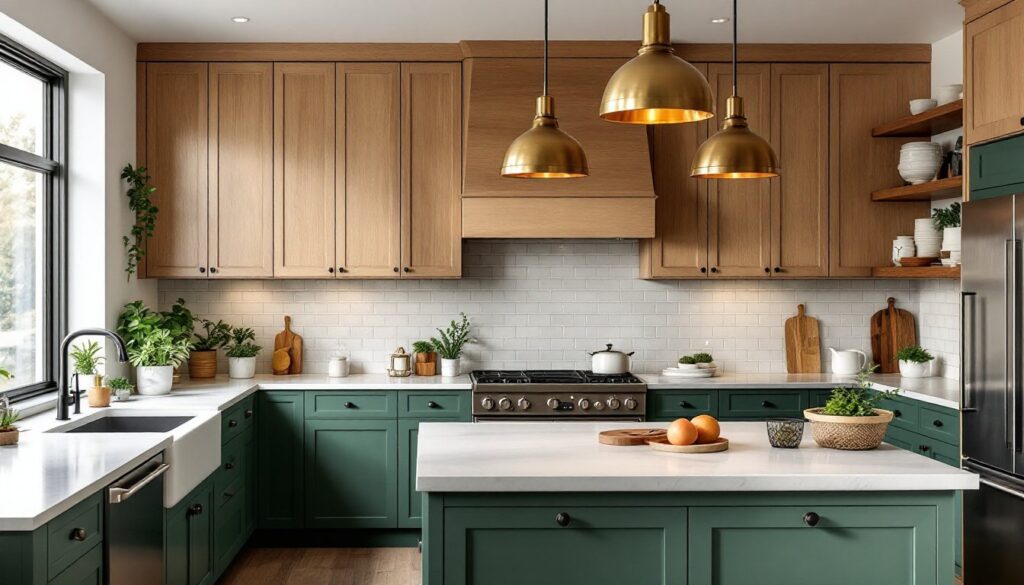
When in doubt, consider how the countertop interacts with cabinetry and backsplash. If cabinets are bold or detailed, a quieter countertop (solid quartz, honed granite) balances the visual weight. If cabinets are simple shaker-style, the countertop can carry more pattern or veining.
Key Design Factors: Color, Pattern, and Edge Profiles
Color impacts perceived space and light. Light countertops (white, cream, light gray) brighten kitchens and make small spaces feel larger. They show crumbs and watermarks more readily. Dark countertops (black, charcoal, deep brown) add drama and hide daily messes but can make a space feel smaller and show dust or water spots. Mid-tone options (taupe, greige, muted green) are forgiving and versatile.
In modern interior layouts, lighter surfaces reflect more ambient and task lighting, reducing the need for additional fixtures. If natural light is limited, avoid very dark stone.
Pattern and veining should be chosen with cabinet door style in mind. Busy granite or marble with heavy veining pairs best with solid-color, simple cabinetry. If cabinets have lots of detail (glass doors, mullions, decorative hardware), a more uniform countertop, like solid quartz or fine-grain granite, prevents visual overload.
Vein direction matters on book-matched or quartzite slabs. Horizontal veining elongates a kitchen: vertical veining draws the eye up. On islands, consider how veining flows across seams. Fabricators can book-match or quarter-match slabs for symmetry, but this increases cost and waste.
Edge profiles affect both style and safety. Common profiles include:
- Eased edge: Slightly rounded, contemporary, easy to clean.
- Half-bullnose: Rounded top edge, flat bottom, traditional and comfortable.
- Bullnose: Fully rounded, soft, safe for kids, suits cottage or traditional kitchens.
- Ogee: Decorative S-curve, formal, harder to clean.
- Mitered or waterfall: Countertop material wraps down the side at a 90° angle, modern and bold.
- Beveled: Angled top edge, transitional look.
Thicker edges (mitered to appear 3″ or more) create a substantial look without the cost or weight of a full-thickness slab. Fabricators laminate a strip of matching material to the underside.
Rounded or eased edges are safer in homes with young children. Sharp corners on stone can chip and pose a safety risk.
Balancing Budget, Durability, and Maintenance
Every countertop material lives somewhere on the triangle of cost, toughness, and upkeep. Here’s how to weigh trade-offs.
Budget tiers:
- Under $40/sq ft installed: Laminate, tile, basic butcher block.
- $40–$80/sq ft: Mid-range granite, quartz, solid surface, upgraded butcher block.
- $80–$150/sq ft: Premium quartz, exotic granite, quartzite, soapstone, marble.
- $150+/sq ft: Rare marble, book-matched slabs, ultra-compact surfaces, custom concrete.
Pricing varies by region, slab availability, and fabrication complexity. Cutouts for sinks, cooktops, and electrical outlets add $50–$150 each. Backsplash height, edge profile upgrades, and seam placement also affect the final invoice.
Durability depends on how the kitchen is used. For heavy cooking, frequent knife work, hot pans, spills, granite, quartz, and soapstone hold up best. Marble and butcher block require more care but reward careful owners with beauty. Laminate is practical for light use but won’t survive a decade of hard wear.
If the kitchen sees a lot of acidic foods (tomatoes, citrus, wine), avoid marble and opt for non-porous quartz or sealed granite. For households with kids, stain-resistant and chip-resistant surfaces (quartz, solid surface) reduce stress.
Maintenance is where many projects stumble. Natural stone (except soapstone) needs annual or bi-annual sealing. Test by dropping water on the surface, if it beads up, the seal is good. If it soaks in within a few minutes, it’s time to reseal. Use a penetrating sealer rated for food surfaces.
Quartz and solid surface need only soap and water. Avoid abrasive cleaners or scouring pads on any surface. Butcher block requires oiling every 4–6 weeks initially, then every few months once a patina develops.
For anyone comparing countertop material options, it’s worth visiting a local stone yard or fabricator showroom. Photos don’t capture the depth, reflectivity, or feel of a slab. Bring cabinet samples and backsplash tiles to check compatibility in natural light.
Installation is not a DIY job for most materials. Stone slabs weigh 400–800 pounds and require a truck, lifting equipment, and precision cutting. Laminate and butcher block are more DIY-friendly if someone has experience with scribing and cutting to fit, but even then, hiring a pro ensures warranty coverage and proper support structure. Countertops must be installed over a solid substrate, typically 3/4″ plywood on top of the cabinet boxes, and supported every 24″ for granite or quartz, every 18″ for marble.
Most fabricators require a template visit after cabinets are installed and level. They’ll create a precise template (using cardboard, thin plywood, or digital laser measuring), then cut and polish the slabs off-site. Installation usually happens 1–2 weeks after templating.
If the kitchen is in a condo or upper floor, check elevator and stairwell dimensions. Some large slabs won’t fit and may need to be cut into smaller pieces, adding seams.
Resale value: Granite and quartz are expected in mid-to-high-end homes. Laminate or tile can hurt resale unless the home is entry-level or a rental. Marble is polarizing, some buyers love it, others see it as high-maintenance. Butcher block appeals to design-forward buyers but may not resonate in traditional markets. If resale is a priority within five years, stick with neutral quartz or granite in white, gray, or black.
Conclusion
Countertop design isn’t one-size-fits-all. The best choice depends on cooking habits, design style, maintenance tolerance, and budget. Start by identifying must-haves, heat resistance, stain resistance, low maintenance, and match materials to those priorities. Visit fabricators with cabinet samples, ask about edge options and seam placement, and get multiple quotes. A well-chosen countertop anchors the kitchen and delivers performance and beauty for decades.